•  
Dong New Year at Zhaoxing Dong Village - Chin

Dong New Year at Zhaoxing Dong Village - Chin

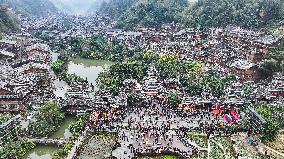
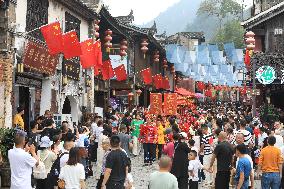
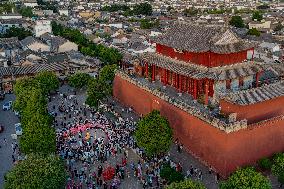
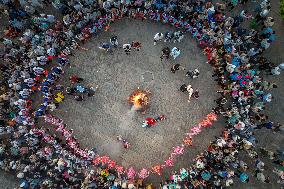
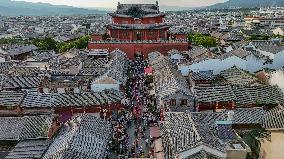
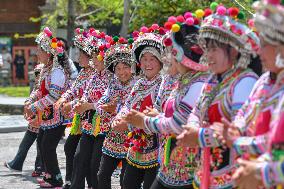
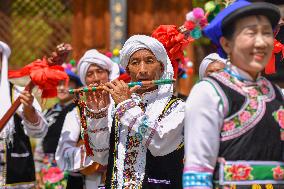
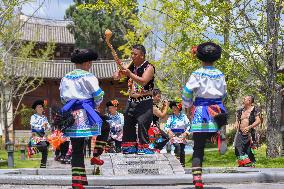
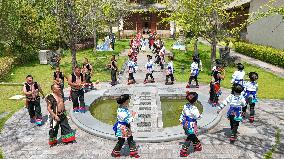
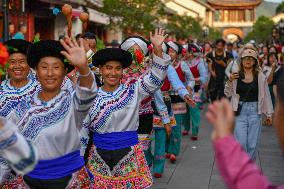
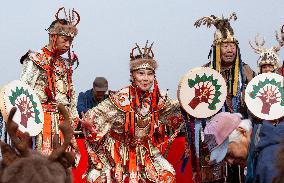
An aerial drone photo taken on Dec. 20, 2025 shows tourists and people of Dong ethnic group celebrating the Dong New Year at Zhaoxing Dong village of Liping County, Qiandongnan Miao and Dong Autonomous Prefecture, southwest China's Guizhou Province. Dong New Year, a traditional festival for harvest and gathering, was enlisted as one of China's national intangible cultural heritages in 2011. Various activities were held in Liping County over the weekend. Photo by Tao Liang /Xinhua/ABACAPRESS.COM

  •  
Dong New Year at Zhaoxing Dong Village - Chin

Dong New Year at Zhaoxing Dong Village - Chin

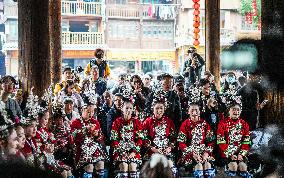
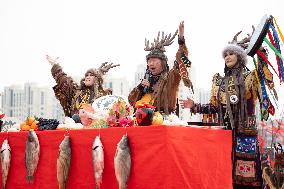
People sing the grand song of the Dong ethnic group at a drum tower during an event in celebration of Dong New Year at Zhaoxing Dong village of Liping County, Qiandongnan Miao and Dong Autonomous Prefecture, southwest China's Guizhou Province, Dec. 20, 2025. Dong New Year, a traditional festival for harvest and gathering, was enlisted as one of China's national intangible cultural heritages in 2011. Various activities were held in Liping County over the weekend. Photo by Tao Liang /Xinhua/ABACAPRESS.COM

  •  
Tie-Dye Technique Of Bai Ethnic Group - Chin

Tie-Dye Technique Of Bai Ethnic Group - Chin

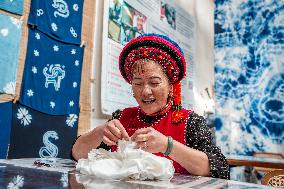
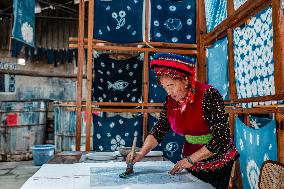
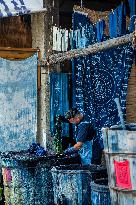
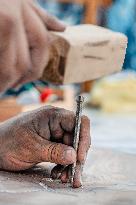
Duan Yuan, an inheritor of the tie-dye technique of Bai ethnic group, makes tie-dye designs in a dyehouse in Zhoucheng Village of Dali Bai Autonomous Prefecture, southwest China's Yunnan Province, November 21, 2025. Known as the hometown of the tie-dye technique of Bai ethnic group, Zhoucheng Village hosts over 200 households engaging in tie-dye businesses, with the number of employees exceeding 4,000. As a traditional folk technique of the Bai ethnic group, tie-dye boasts a history spanning over a thousand years and was included in the first batch of China's national intangible cultural heritage list in 2006. Tying and dyeing are the core steps in the process of making indigo tie-dye products. Artisans use needles and threads to create various patterns on the fabric, which are then dyed with plant-based dyes, resulting in blue backgrounds adorned with vivid white patterns. Photo by Hu Chao/Xinhua/ABACAPRESS.COM

  •  
Tie-Dye Technique Of Bai Ethnic Group - Chin

Tie-Dye Technique Of Bai Ethnic Group - Chin

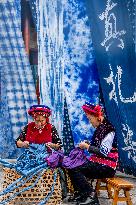
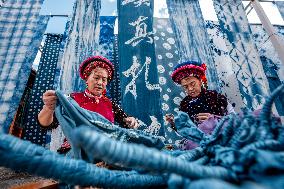
Duan Yinmei, an inheritor of the tie-dye technique of Bai ethnic group, creates knots on fabrics in a dyehouse in Zhoucheng Village of Dali Bai Autonomous Prefecture, southwest China's Yunnan Province, November 21, 2025. Known as the hometown of the tie-dye technique of Bai ethnic group, Zhoucheng Village hosts over 200 households engaging in tie-dye businesses, with the number of employees exceeding 4,000. As a traditional folk technique of the Bai ethnic group, tie-dye boasts a history spanning over a thousand years and was included in the first batch of China's national intangible cultural heritage list in 2006. Tying and dyeing are the core steps in the process of making indigo tie-dye products. Artisans use needles and threads to create various patterns on the fabric, which are then dyed with plant-based dyes, resulting in blue backgrounds adorned with vivid white patterns. Photo by Hu Chao/Xinhua/ABACAPRESS.COM

  •  
Tie-Dye Technique Of Bai Ethnic Group - Chin

Tie-Dye Technique Of Bai Ethnic Group - Chin

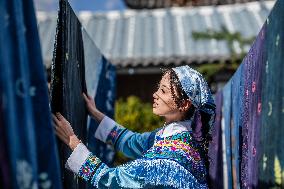
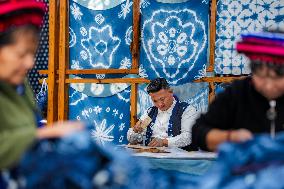
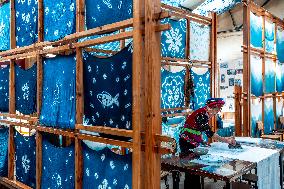
A woman experiences the tie-dye technique of Bai ethnic group in a dyehouse in Zhoucheng Village of Dali Bai Autonomous Prefecture, southwest China's Yunnan Province, November 21, 2025. Known as the hometown of the tie-dye technique of Bai ethnic group, Zhoucheng Village hosts over 200 households engaging in tie-dye businesses, with the number of employees exceeding 4,000. As a traditional folk technique of the Bai ethnic group, tie-dye boasts a history spanning over a thousand years and was included in the first batch of China's national intangible cultural heritage list in 2006. Tying and dyeing are the core steps in the process of making indigo tie-dye products. Artisans use needles and threads to create various patterns on the fabric, which are then dyed with plant-based dyes, resulting in blue backgrounds adorned with vivid white patterns. Photo by Hu Chao/Xinhua/ABACAPRESS.COM

  •  
Tie-Dye Technique Of Bai Ethnic Group - Chin

Tie-Dye Technique Of Bai Ethnic Group - Chin

Duan Yinmei, an inheritor of the tie-dye technique of Bai ethnic group, dyes patterns on fabrics in a dyehouse in Zhoucheng Village of Dali Bai Autonomous Prefecture, southwest China's Yunnan Province, November 21, 2025. Known as the hometown of the tie-dye technique of Bai ethnic group, Zhoucheng Village hosts over 200 households engaging in tie-dye businesses, with the number of employees exceeding 4,000. As a traditional folk technique of the Bai ethnic group, tie-dye boasts a history spanning over a thousand years and was included in the first batch of China's national intangible cultural heritage list in 2006. Tying and dyeing are the core steps in the process of making indigo tie-dye products. Artisans use needles and threads to create various patterns on the fabric, which are then dyed with plant-based dyes, resulting in blue backgrounds adorned with vivid white patterns. Photo by Hu Chao/Xinhua/ABACAPRESS.COM

  •  
Tie-Dye Technique Of Bai Ethnic Group - Chin

Tie-Dye Technique Of Bai Ethnic Group - Chin

Duan Yuan, an inheritor of the tie-dye technique of Bai ethnic group, rinses dyed fabrics in a dyehouse in Zhoucheng Village of Dali Bai Autonomous Prefecture, southwest China's Yunnan Province, November 21, 2025. Known as the hometown of the tie-dye technique of Bai ethnic group, Zhoucheng Village hosts over 200 households engaging in tie-dye businesses, with the number of employees exceeding 4,000. As a traditional folk technique of the Bai ethnic group, tie-dye boasts a history spanning over a thousand years and was included in the first batch of China's national intangible cultural heritage list in 2006. Tying and dyeing are the core steps in the process of making indigo tie-dye products. Artisans use needles and threads to create various patterns on the fabric, which are then dyed with plant-based dyes, resulting in blue backgrounds adorned with vivid white patterns. Photo by Hu Chao/Xinhua/ABACAPRESS.COM

  •  
Tie-Dye Technique Of Bai Ethnic Group - Chin

Tie-Dye Technique Of Bai Ethnic Group - Chin

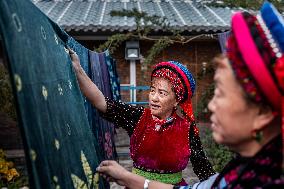
Duan Yinmei (L), an inheritor of the tie-dye technique of Bai ethnic group, and handicraftsman Duan Lilan dry tie-dye fabrics in a dyehouse in Zhoucheng Village of Dali Bai Autonomous Prefecture, southwest China's Yunnan Province, November 21, 2025. Known as the hometown of the tie-dye technique of Bai ethnic group, Zhoucheng Village hosts over 200 households engaging in tie-dye businesses, with the number of employees exceeding 4,000. As a traditional folk technique of the Bai ethnic group, tie-dye boasts a history spanning over a thousand years and was included in the first batch of China's national intangible cultural heritage list in 2006. Tying and dyeing are the core steps in the process of making indigo tie-dye products. Artisans use needles and threads to create various patterns on the fabric, which are then dyed with plant-based dyes, resulting in blue backgrounds adorned with vivid white patterns. Photo by Hu Chao/Xinhua/ABACAPRESS.COM

  •  
Tie-Dye Technique Of Bai Ethnic Group - Chin

Tie-Dye Technique Of Bai Ethnic Group - Chin

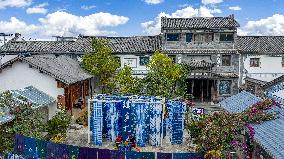
An aerial drone photo shows a scene at a dyehouse in Zhoucheng Village of Dali Bai Autonomous Prefecture, southwest China's Yunnan Province, November 21, 2025. Known as the hometown of the tie-dye technique of Bai ethnic group, Zhoucheng Village hosts over 200 households engaging in tie-dye businesses, with the number of employees exceeding 4,000. As a traditional folk technique of the Bai ethnic group, tie-dye boasts a history spanning over a thousand years and was included in the first batch of China's national intangible cultural heritage list in 2006. Tying and dyeing are the core steps in the process of making indigo tie-dye products. Artisans use needles and threads to create various patterns on the fabric, which are then dyed with plant-based dyes, resulting in blue backgrounds adorned with vivid white patterns. Photo by Hu Chao/Xinhua/ABACAPRESS.COM

  •  
Tie-Dye Technique Of Bai Ethnic Group - Chin

Tie-Dye Technique Of Bai Ethnic Group - Chin

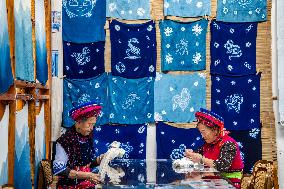
Duan Yinmei (L), an inheritor of the tie-dye technique of Bai ethnic group, and handicraftsman Duan Lilan untie knots on fabrics in a dyehouse in Zhoucheng Village of Dali Bai Autonomous Prefecture, southwest China's Yunnan Province, November 21, 2025. Known as the hometown of the tie-dye technique of Bai ethnic group, Zhoucheng Village hosts over 200 households engaging in tie-dye businesses, with the number of employees exceeding 4,000. As a traditional folk technique of the Bai ethnic group, tie-dye boasts a history spanning over a thousand years and was included in the first batch of China's national intangible cultural heritage list in 2006. Tying and dyeing are the core steps in the process of making indigo tie-dye products. Artisans use needles and threads to create various patterns on the fabric, which are then dyed with plant-based dyes, resulting in blue backgrounds adorned with vivid white patterns. Photo by Hu Chao/Xinhua/ABACAPRESS.COM

  •  
Tie-Dye Technique Of Bai Ethnic Group - Chin

Tie-Dye Technique Of Bai Ethnic Group - Chin

Duan Yinmei (L), an inheritor of the tie-dye technique of Bai ethnic group, and handicraftsman Duan Lilan untie knots on fabrics in a dyehouse in Zhoucheng Village of Dali Bai Autonomous Prefecture, southwest China's Yunnan Province, November 21, 2025. Known as the hometown of the tie-dye technique of Bai ethnic group, Zhoucheng Village hosts over 200 households engaging in tie-dye businesses, with the number of employees exceeding 4,000. As a traditional folk technique of the Bai ethnic group, tie-dye boasts a history spanning over a thousand years and was included in the first batch of China's national intangible cultural heritage list in 2006. Tying and dyeing are the core steps in the process of making indigo tie-dye products. Artisans use needles and threads to create various patterns on the fabric, which are then dyed with plant-based dyes, resulting in blue backgrounds adorned with vivid white patterns. Photo by Hu Chao/Xinhua/ABACAPRESS.COM

  •  
Tie-Dye Technique Of Bai Ethnic Group - Chin

Tie-Dye Technique Of Bai Ethnic Group - Chin

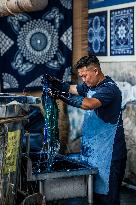
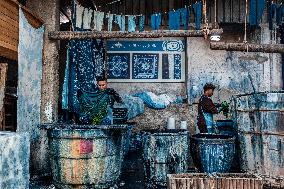
Duan Yuan (L), an inheritor of the tie-dye technique of Bai ethnic group, dyes fabrics in a dyehouse in Zhoucheng Village of Dali Bai Autonomous Prefecture, southwest China's Yunnan Province, November 21, 2025. Known as the hometown of the tie-dye technique of Bai ethnic group, Zhoucheng Village hosts over 200 households engaging in tie-dye businesses, with the number of employees exceeding 4,000. As a traditional folk technique of the Bai ethnic group, tie-dye boasts a history spanning over a thousand years and was included in the first batch of China's national intangible cultural heritage list in 2006. Tying and dyeing are the core steps in the process of making indigo tie-dye products. Artisans use needles and threads to create various patterns on the fabric, which are then dyed with plant-based dyes, resulting in blue backgrounds adorned with vivid white patterns. Photo by Hu Chao/Xinhua/ABACAPRESS.COM

  •  
Tie-Dye Technique Of Bai Ethnic Group - Chin

Tie-Dye Technique Of Bai Ethnic Group - Chin

Duan Yuan, an inheritor of the tie-dye technique of Bai ethnic group, makes tie-dye designs in a dyehouse in Zhoucheng Village of Dali Bai Autonomous Prefecture, southwest China's Yunnan Province, November 21, 2025. Known as the hometown of the tie-dye technique of Bai ethnic group, Zhoucheng Village hosts over 200 households engaging in tie-dye businesses, with the number of employees exceeding 4,000. As a traditional folk technique of the Bai ethnic group, tie-dye boasts a history spanning over a thousand years and was included in the first batch of China's national intangible cultural heritage list in 2006. Tying and dyeing are the core steps in the process of making indigo tie-dye products. Artisans use needles and threads to create various patterns on the fabric, which are then dyed with plant-based dyes, resulting in blue backgrounds adorned with vivid white patterns. Photo by Hu Chao/Xinhua/ABACAPRESS.COM

  •  
Tie-Dye Technique Of Bai Ethnic Group - Chin

Tie-Dye Technique Of Bai Ethnic Group - Chin

Duan Yuan, an inheritor of the tie-dye technique of Bai ethnic group, dyes fabrics in a dyehouse in Zhoucheng Village of Dali Bai Autonomous Prefecture, southwest China's Yunnan Province, November 21, 2025. Known as the hometown of the tie-dye technique of Bai ethnic group, Zhoucheng Village hosts over 200 households engaging in tie-dye businesses, with the number of employees exceeding 4,000. As a traditional folk technique of the Bai ethnic group, tie-dye boasts a history spanning over a thousand years and was included in the first batch of China's national intangible cultural heritage list in 2006. Tying and dyeing are the core steps in the process of making indigo tie-dye products. Artisans use needles and threads to create various patterns on the fabric, which are then dyed with plant-based dyes, resulting in blue backgrounds adorned with vivid white patterns. Photo by Hu Chao/Xinhua/ABACAPRESS.COM

  •  
Tie-Dye Technique Of Bai Ethnic Group - Chin

Tie-Dye Technique Of Bai Ethnic Group - Chin

Duan Yuan, an inheritor of the tie-dye technique of Bai ethnic group, dyes fabrics in a dyehouse in Zhoucheng Village of Dali Bai Autonomous Prefecture, southwest China's Yunnan Province, November 21, 2025. Known as the hometown of the tie-dye technique of Bai ethnic group, Zhoucheng Village hosts over 200 households engaging in tie-dye businesses, with the number of employees exceeding 4,000. As a traditional folk technique of the Bai ethnic group, tie-dye boasts a history spanning over a thousand years and was included in the first batch of China's national intangible cultural heritage list in 2006. Tying and dyeing are the core steps in the process of making indigo tie-dye products. Artisans use needles and threads to create various patterns on the fabric, which are then dyed with plant-based dyes, resulting in blue backgrounds adorned with vivid white patterns. Photo by Hu Chao/Xinhua/ABACAPRESS.COM

  •  
Tie-Dye Technique Of Bai Ethnic Group - Chin

Tie-Dye Technique Of Bai Ethnic Group - Chin

Duan Yuan, an inheritor of the tie-dye technique of Bai ethnic group, makes tie-dye designs in a dyehouse in Zhoucheng Village of Dali Bai Autonomous Prefecture, southwest China's Yunnan Province, November 21, 2025. Known as the hometown of the tie-dye technique of Bai ethnic group, Zhoucheng Village hosts over 200 households engaging in tie-dye businesses, with the number of employees exceeding 4,000. As a traditional folk technique of the Bai ethnic group, tie-dye boasts a history spanning over a thousand years and was included in the first batch of China's national intangible cultural heritage list in 2006. Tying and dyeing are the core steps in the process of making indigo tie-dye products. Artisans use needles and threads to create various patterns on the fabric, which are then dyed with plant-based dyes, resulting in blue backgrounds adorned with vivid white patterns. Photo by Hu Chao/Xinhua/ABACAPRESS.COM

  •  
Tie-Dye Technique Of Bai Ethnic Group - Chin

Tie-Dye Technique Of Bai Ethnic Group - Chin

Duan Yinmei, an inheritor of the tie-dye technique of Bai ethnic group, unties knots on fabrics in a dyehouse in Zhoucheng Village of Dali Bai Autonomous Prefecture, southwest China's Yunnan Province, November 21, 2025. Known as the hometown of the tie-dye technique of Bai ethnic group, Zhoucheng Village hosts over 200 households engaging in tie-dye businesses, with the number of employees exceeding 4,000. As a traditional folk technique of the Bai ethnic group, tie-dye boasts a history spanning over a thousand years and was included in the first batch of China's national intangible cultural heritage list in 2006. Tying and dyeing are the core steps in the process of making indigo tie-dye products. Artisans use needles and threads to create various patterns on the fabric, which are then dyed with plant-based dyes, resulting in blue backgrounds adorned with vivid white patterns. Photo by Hu Chao/Xinhua/ABACAPRESS.COM

  •  
Tie-Dye Technique Of Bai Ethnic Group - Chin

Tie-Dye Technique Of Bai Ethnic Group - Chin

Duan Yinmei, an inheritor of the tie-dye technique of Bai ethnic group, dyes patterns on fabrics in a dyehouse in Zhoucheng Village of Dali Bai Autonomous Prefecture, southwest China's Yunnan Province, November 21, 2025. Known as the hometown of the tie-dye technique of Bai ethnic group, Zhoucheng Village hosts over 200 households engaging in tie-dye businesses, with the number of employees exceeding 4,000. As a traditional folk technique of the Bai ethnic group, tie-dye boasts a history spanning over a thousand years and was included in the first batch of China's national intangible cultural heritage list in 2006. Tying and dyeing are the core steps in the process of making indigo tie-dye products. Artisans use needles and threads to create various patterns on the fabric, which are then dyed with plant-based dyes, resulting in blue backgrounds adorned with vivid white patterns. Photo by Hu Chao/Xinhua/ABACAPRESS.COM

  •  
Tie-Dye Technique Of Bai Ethnic Group - Chin

Tie-Dye Technique Of Bai Ethnic Group - Chin

Duan Yinmei (R), an inheritor of the tie-dye technique of Bai ethnic group, and handicraftsman Duan Lilan create knots on fabrics in a dyehouse in Zhoucheng Village of Dali Bai Autonomous Prefecture, southwest China's Yunnan Province, November 21, 2025. Known as the hometown of the tie-dye technique of Bai ethnic group, Zhoucheng Village hosts over 200 households engaging in tie-dye businesses, with the number of employees exceeding 4,000. As a traditional folk technique of the Bai ethnic group, tie-dye boasts a history spanning over a thousand years and was included in the first batch of China's national intangible cultural heritage list in 2006. Tying and dyeing are the core steps in the process of making indigo tie-dye products. Artisans use needles and threads to create various patterns on the fabric, which are then dyed with plant-based dyes, resulting in blue backgrounds adorned with vivid white patterns. Photo by Hu Chao/Xinhua/ABACAPRESS.COM

  •  
Cultural Tourism During National Day In China - China

Cultural Tourism During National Day In China - China

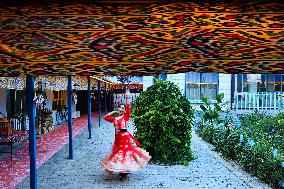
Tourists watch a wedding custom performance of Tujia ethnic group at an ancient town in Xiushan Tujia and Miao Autonomous County, southwest China's Chongqing Municipality, Oct. 1, 2025. This year, with China's Mid-Autumn Festival falling alongside National Day, an eight-day holiday starting Wednesday is set to energize local economies through a surge in cultural tourism. Photo by Hu Cheng/Xinhua/ABACAPRESS.COM

  •  
Daily life in Tacheng City

Daily life in Tacheng City

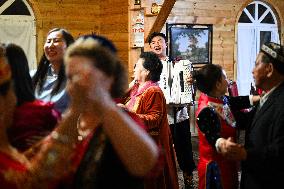
A guest from Kazakh ethnic group plays accordion after a meal while other guests dance at the agritainment of Ma Xiuhua in Tacheng City, northwest China's Xinjiang Uygur Autonomous Region, September 17, 2025. Ma Xiuhua, 60, is a native of Tacheng. Together with her husband, she built an agritainment named "Friends Manor" in their hometown, where they welcome guests from all over the country. Tacheng is home to over 20 ethnic groups, with a population of less than 160,000. Members of Ma's family themselves come from a variety of ethnic backgrounds. Whenever guests arrive at "Friends Manor," Ma greets them with warm hospitality, treating them to her signature homemade dishes and fresh fruits harvested right from the courtyard. She often invites them to sing and dance together, letting the joyful mood fill the air. Xinjiang is a multiethnic region and the agritainment of Ma is expecting more friends from various ethnic groups. (Xinhua/Xin Yuewei)

  •  
Daily life in Tacheng City

Daily life in Tacheng City

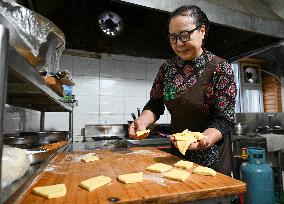
Ma Xiuhua makes a dish of Kazakh ethnic group in Tacheng City, northwest China's Xinjiang Uygur Autonomous Region, September 17, 2025. Ma Xiuhua, 60, is a native of Tacheng. Together with her husband, she built an agritainment named "Friends Manor" in their hometown, where they welcome guests from all over the country. Tacheng is home to over 20 ethnic groups, with a population of less than 160,000. Members of Ma's family themselves come from a variety of ethnic backgrounds. Whenever guests arrive at "Friends Manor," Ma greets them with warm hospitality, treating them to her signature homemade dishes and fresh fruits harvested right from the courtyard. She often invites them to sing and dance together, letting the joyful mood fill the air. Xinjiang is a multiethnic region and the agritainment of Ma is expecting more friends from various ethnic groups. (Xinhua/Chen Shuo)

  •  
Daily life in Tacheng City

Daily life in Tacheng City

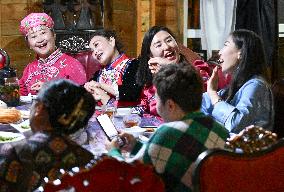
A guest from Xibe ethnic group (1st L) sings with other guests during a meal at the agritainment of Ma Xiuhua in Tacheng City, northwest China's Xinjiang Uygur Autonomous Region, September 17, 2025. Ma Xiuhua, 60, is a native of Tacheng. Together with her husband, she built an agritainment named "Friends Manor" in their hometown, where they welcome guests from all over the country. Tacheng is home to over 20 ethnic groups, with a population of less than 160,000. Members of Ma's family themselves come from a variety of ethnic backgrounds. Whenever guests arrive at "Friends Manor," Ma greets them with warm hospitality, treating them to her signature homemade dishes and fresh fruits harvested right from the courtyard. She often invites them to sing and dance together, letting the joyful mood fill the air. Xinjiang is a multiethnic region and the agritainment of Ma is expecting more friends from various ethnic groups. Photo by Wang Fei/Xinhua/ABACAPRESS/COM

  •  
Daily life in Tacheng City

Daily life in Tacheng City

A guest from Daur ethnic group dances after a meal at the agritainment of Ma Xiuhua in Tacheng City, northwest China's Xinjiang Uygur Autonomous Region, September 17, 2025. Ma Xiuhua, 60, is a native of Tacheng. Together with her husband, she built an agritainment named "Friends Manor" in their hometown, where they welcome guests from all over the country. Tacheng is home to over 20 ethnic groups, with a population of less than 160,000. Members of Ma's family themselves come from a variety of ethnic backgrounds. Whenever guests arrive at "Friends Manor," Ma greets them with warm hospitality, treating them to her signature homemade dishes and fresh fruits harvested right from the courtyard. She often invites them to sing and dance together, letting the joyful mood fill the air. Xinjiang is a multiethnic region and the agritainment of Ma is expecting more friends from various ethnic groups. (Xinhua/Xin Yuewei)

  •  
Daily life in Tacheng City

Daily life in Tacheng City

A guest from Kazakh ethnic group dances at the agritainment of Ma Xiuhua in Tacheng City, northwest China's Xinjiang Uygur Autonomous Region, September 17, 2025. Ma Xiuhua, 60, is a native of Tacheng. Together with her husband, she built an agritainment named "Friends Manor" in their hometown, where they welcome guests from all over the country. Tacheng is home to over 20 ethnic groups, with a population of less than 160,000. Members of Ma's family themselves come from a variety of ethnic backgrounds. Whenever guests arrive at "Friends Manor," Ma greets them with warm hospitality, treating them to her signature homemade dishes and fresh fruits harvested right from the courtyard. She often invites them to sing and dance together, letting the joyful mood fill the air. Xinjiang is a multiethnic region and the agritainment of Ma is expecting more friends from various ethnic groups. (Xinhua/Xin Yuewei)

  •  
Chinese President Xi Jinping Visits Lhasa - China

Chinese President Xi Jinping Visits Lhasa - China

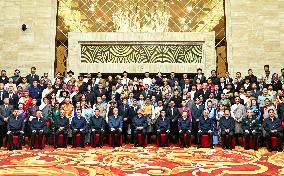
Chinese President Xi Jinping, also general secretary of the Communist Party of China Central Committee and chairman of the Central Military Commission, poses for a group photo while meeting with representatives from all ethnic groups and all walks of life in the plateau region in Lhasa, southwest China's Xizang Autonomous Region, August 20, 2025. Photo by Xinhua/Yan Yan/ABACAPRESS.COM

  •  
Torch Festival Celebrations In Sichuan - China

Torch Festival Celebrations In Sichuan - China

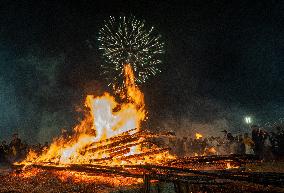
Tourists and locals dance around a bonfire at a torch festival in Butuo County, southwest China's Sichuan Province, July 22, 2025. A traditional torch festival of Yi ethnic group was held here from July 21 to 23, featuring various activities including costume displays, campfire party, traditional ethnic sports events, dancing and traditional beauty contest. Photo by Jiang Hongjing/Xinhua/ABACAPRESS.COM

  •  
Torch Festival Celebrations In Sichuan - China

Torch Festival Celebrations In Sichuan - China

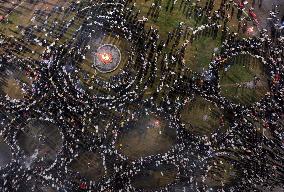
An aerial drone photo shows tourists and locals celebrating a torch festival in Butuo County, southwest China's Sichuan Province, July 22, 2025. A traditional torch festival of Yi ethnic group was held here from July 21 to 23, featuring various activities including costume displays, campfire party, traditional ethnic sports events, dancing and traditional beauty contest. Photo by Jiang Hongjing/Xinhua/ABACAPRESS.COM

  •  
Ainu people hold ritual in Hokkaido

Ainu people hold ritual in Hokkaido

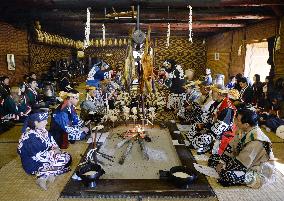
Indigenous Ainu people take part in a "kotan-nomi" ritual to celebrate the autumn harvest on Nov. 1, 2015, at a museum dedicated to the ethnic minority group in the Hokkaido town of Shiraoi, northern Japan.

  •  
Yizu Dage Presentation in Yunnan - China

Yizu Dage Presentation in Yunnan - China

An aerial drone photo taken on July 18, 2025 shows a local Yizu Dage team performing during a parade show on a square in Weishan Yi and Hui Autonomous County, Dali Bai Autonomous Prefecture, southwest China's Yunnan Province. Yizu Dage, a traditional folk art of the Yi ethnic group usually performed during festivals, weddings, funerals and other gathering occasions, has a history of about 10 centuries and was listed as a national-level intangible cultural heritage in 2008. Weishan is dubbed "cradle of Yizu Dage." Provincial and prefecture authorities of Yunnan have rolled out policies and dedicated funds in support of the development and popularization of Dage art. To date, Dage art is not only integral part of local people's daily life, but also a major tourist attraction. Photo by Peng Yikai /Xinhua/ABACAPRESS.COM

  •  
Yizu Dage Presentation in Yunnan - China

Yizu Dage Presentation in Yunnan - China

An aerial drone photo taken on July 18, 2025 shows a local Yizu Dage team performing during a parade show on a square in Weishan Yi and Hui Autonomous County, Dali Bai Autonomous Prefecture, southwest China's Yunnan Province. Yizu Dage, a traditional folk art of the Yi ethnic group usually performed during festivals, weddings, funerals and other gathering occasions, has a history of about 10 centuries and was listed as a national-level intangible cultural heritage in 2008. Weishan is dubbed "cradle of Yizu Dage." Provincial and prefecture authorities of Yunnan have rolled out policies and dedicated funds in support of the development and popularization of Dage art. To date, Dage art is not only integral part of local people's daily life, but also a major tourist attraction. Photo by Peng Yikai /Xinhua/ABACAPRESS.COM

  •  
Yizu Dage Presentation in Yunnan - China

Yizu Dage Presentation in Yunnan - China

An aerial drone photo taken on July 18, 2025 shows a local Yizu Dage team performing during a parade show on the ancient street of Nanzhao in Weishan Yi and Hui Autonomous County, Dali Bai Autonomous Prefecture, southwest China's Yunnan Province. Yizu Dage, a traditional folk art of the Yi ethnic group usually performed during festivals, weddings, funerals and other gathering occasions, has a history of about 10 centuries and was listed as a national-level intangible cultural heritage in 2008. Weishan is dubbed "cradle of Yizu Dage." Provincial and prefecture authorities of Yunnan have rolled out policies and dedicated funds in support of the development and popularization of Dage art. To date, Dage art is not only integral part of local people's daily life, but also a major tourist attraction. Photo by Peng Yikai /Xinhua/ABACAPRESS.COM

  •  
Yizu Dage Presentation in Yunnan - China

Yizu Dage Presentation in Yunnan - China

An aerial drone photo taken on July 18, 2025 shows a local Yizu Dage team attending a rehearsal in Weishan Yi and Hui Autonomous County, Dali Bai Autonomous Prefecture, southwest China's Yunnan Province. Yizu Dage, a traditional folk art of the Yi ethnic group usually performed during festivals, weddings, funerals and other gathering occasions, has a history of about 10 centuries and was listed as a national-level intangible cultural heritage in 2008. Weishan is dubbed "cradle of Yizu Dage." Provincial and prefecture authorities of Yunnan have rolled out policies and dedicated funds in support of the development and popularization of Dage art. To date, Dage art is not only integral part of local people's daily life, but also a major tourist attraction. Photo by Peng Yikai /Xinhua/ABACAPRESS.COM

  •  
Yizu Dage Presentation in Yunnan - China

Yizu Dage Presentation in Yunnan - China

Members of a local Yizu Dage team attend a rehearsal in Weishan Yi and Hui Autonomous County, Dali Bai Autonomous Prefecture, southwest China's Yunnan Province, July 18, 2025. Yizu Dage, a traditional folk art of the Yi ethnic group usually performed during festivals, weddings, funerals and other gathering occasions, has a history of about 10 centuries and was listed as a national-level intangible cultural heritage in 2008. Weishan is dubbed "cradle of Yizu Dage." Provincial and prefecture authorities of Yunnan have rolled out policies and dedicated funds in support of the development and popularization of Dage art. To date, Dage art is not only integral part of local people's daily life, but also a major tourist attraction. Photo by Peng Yikai /Xinhua/ABACAPRESS.COM

  •  
Yizu Dage Presentation in Yunnan - China

Yizu Dage Presentation in Yunnan - China

Members of a local Yizu Dage team attend a rehearsal in Weishan Yi and Hui Autonomous County, Dali Bai Autonomous Prefecture, southwest China's Yunnan Province, July 18, 2025. Yizu Dage, a traditional folk art of the Yi ethnic group usually performed during festivals, weddings, funerals and other gathering occasions, has a history of about 10 centuries and was listed as a national-level intangible cultural heritage in 2008. Weishan is dubbed "cradle of Yizu Dage." Provincial and prefecture authorities of Yunnan have rolled out policies and dedicated funds in support of the development and popularization of Dage art. To date, Dage art is not only integral part of local people's daily life, but also a major tourist attraction. Photo by Peng Yikai /Xinhua/ABACAPRESS.COM

  •  
Yizu Dage Presentation in Yunnan - China

Yizu Dage Presentation in Yunnan - China

Members of a local Yizu Dage team attend a rehearsal in Weishan Yi and Hui Autonomous County, Dali Bai Autonomous Prefecture, southwest China's Yunnan Province, July 18, 2025. Yizu Dage, a traditional folk art of the Yi ethnic group usually performed during festivals, weddings, funerals and other gathering occasions, has a history of about 10 centuries and was listed as a national-level intangible cultural heritage in 2008. Weishan is dubbed "cradle of Yizu Dage." Provincial and prefecture authorities of Yunnan have rolled out policies and dedicated funds in support of the development and popularization of Dage art. To date, Dage art is not only integral part of local people's daily life, but also a major tourist attraction. Photo by Peng Yikai /Xinhua/ABACAPRESS.COM

  •  
Yizu Dage Presentation in Yunnan - China

Yizu Dage Presentation in Yunnan - China

A young member of a local Yizu Dage team attends a rehearsal in Weishan Yi and Hui Autonomous County, Dali Bai Autonomous Prefecture, southwest China's Yunnan Province, July 18, 2025. Yizu Dage, a traditional folk art of the Yi ethnic group usually performed during festivals, weddings, funerals and other gathering occasions, has a history of about 10 centuries and was listed as a national-level intangible cultural heritage in 2008. Weishan is dubbed "cradle of Yizu Dage." Provincial and prefecture authorities of Yunnan have rolled out policies and dedicated funds in support of the development and popularization of Dage art. To date, Dage art is not only integral part of local people's daily life, but also a major tourist attraction. Photo by Peng Yikai /Xinhua/ABACAPRESS.COM

  •  
Yizu Dage Presentation in Yunnan - China

Yizu Dage Presentation in Yunnan - China

A drone photo taken on July 18, 2025 shows members of a local Yizu Dage team attending a rehearsal in Weishan Yi and Hui Autonomous County, Dali Bai Autonomous Prefecture, southwest China's Yunnan Province. Yizu Dage, a traditional folk art of the Yi ethnic group usually performed during festivals, weddings, funerals and other gathering occasions, has a history of about 10 centuries and was listed as a national-level intangible cultural heritage in 2008. Weishan is dubbed "cradle of Yizu Dage." Provincial and prefecture authorities of Yunnan have rolled out policies and dedicated funds in support of the development and popularization of Dage art. To date, Dage art is not only integral part of local people's daily life, but also a major tourist attraction. Photo by Peng Yikai /Xinhua/ABACAPRESS.COM

  •  
Yizu Dage Presentation in Yunnan - China

Yizu Dage Presentation in Yunnan - China

Members of a local Yizu Dage team wave to tourists during a parade show on the ancient street of Nanzhao in Weishan Yi and Hui Autonomous County, Dali Bai Autonomous Prefecture, southwest China's Yunnan Province, July 18, 2025. Yizu Dage, a traditional folk art of the Yi ethnic group usually performed during festivals, weddings, funerals and other gathering occasions, has a history of about 10 centuries and was listed as a national-level intangible cultural heritage in 2008. Weishan is dubbed "cradle of Yizu Dage." Provincial and prefecture authorities of Yunnan have rolled out policies and dedicated funds in support of the development and popularization of Dage art. To date, Dage art is not only integral part of local people's daily life, but also a major tourist attraction. Photo by Peng Yikai /Xinhua/ABACAPRESS.COM

  •  
Yizu Dage Presentation in Yunnan - China

Yizu Dage Presentation in Yunnan - China

Young members of a local Yizu Dage team take a break during practices in Weishan Yi and Hui Autonomous County, Dali Bai Autonomous Prefecture, southwest China's Yunnan Province, July 18, 2025. Yizu Dage, a traditional folk art of the Yi ethnic group usually performed during festivals, weddings, funerals and other gathering occasions, has a history of about 10 centuries and was listed as a national-level intangible cultural heritage in 2008. Weishan is dubbed "cradle of Yizu Dage." Provincial and prefecture authorities of Yunnan have rolled out policies and dedicated funds in support of the development and popularization of Dage art. To date, Dage art is not only integral part of local people's daily life, but also a major tourist attraction. Photo by Peng Yikai /Xinhua/ABACAPRESS.COM

  •  
Enshi Summer Resort - China

Enshi Summer Resort - China

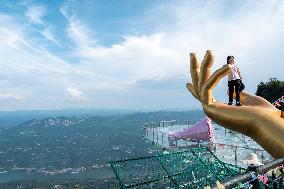
An aerial drone photo taken on July 7, 2025 shows tourists visiting a glass skywalk in Shuibuya Township of Badong County, Enshi Tujia and Miao Autonomous Prefecture, central China's Hubei Province. Enshi is a well-known summer travel destination in central China. Tapping diverse ecological resources, such as unique karst landforms, pleasant alpine climate, and dense primeval forests, the local authorities have actively developed summer tourism, and meticulously created diversified tourism products, like exploring canyon and cave, rafting on Qingjiang River and experiencing the culture of Tujia ethnic group. Photo by Yang Shunpi/Xinhua/ABACAPRESS.COM

  •  
Enshi Summer Resort - China

Enshi Summer Resort - China

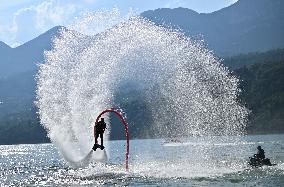
A staff member of the aquatic sports center performs a "Water Flyer" show in Jianshi County, Enshi Tujia and Miao Autonomous Prefecture, central China's Hubei Province, July 7, 2025. Enshi is a well-known summer travel destination in central China. Tapping diverse ecological resources, such as unique karst landforms, pleasant alpine climate, and dense primeval forests, the local authorities have actively developed summer tourism, and meticulously created diversified tourism products, like exploring canyon and cave, rafting on Qingjiang River and experiencing the culture of Tujia ethnic group. Photo by Song Wen/Xinhua/ABACAPRESS.COM

  •  
Enshi Summer Resort - China

Enshi Summer Resort - China

A tourist visits a scenic area in Jianshi County, Enshi Tujia and Miao Autonomous Prefecture, central China's Hubei Province, July 7, 2025. Enshi is a well-known summer travel destination in central China. Tapping diverse ecological resources, such as unique karst landforms, pleasant alpine climate, and dense primeval forests, the local authorities have actively developed summer tourism and meticulously created diversified tourism products, like exploring canyon and cave, rafting on Qingjiang River and experiencing the culture of Tujia ethnic group. (Xinhua/Wu Zhizun/ABACAPRESS.COM

  •  
Enshi Summer Resort - China

Enshi Summer Resort - China

An aerial drone photo taken on July 7, 2025 shows tourists experiencing water sports activities at an aquatic sports center in Jianshi County, Enshi Tujia and Miao Autonomous Prefecture, central China's Hubei Province. Enshi is a well-known summer travel destination in central China. Tapping diverse ecological resources, such as unique karst landforms, pleasant alpine climate, and dense primeval forests, the local authorities have actively developed summer tourism, and meticulously created diversified tourism products, like exploring canyon and cave, rafting on Qingjiang River and experiencing the culture of Tujia ethnic group. Photo by Zheng Jiayu/Xinhua/ABACAPRESS.COM

  •  
Village Super League - China

Village Super League - China

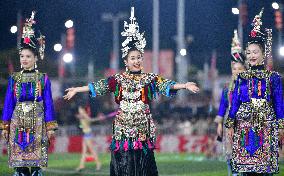
( Chorus members perform the grand song of the Dong ethnic group in "Ne Zha 2" during the "Village Super League," or "Cun Chao," in Rongjiang County, southwest China's Guizhou Province, March 14, 2025. Xinhua/Yang Wenbin/ABACAPRESS.CO

  •  
Hanjiang Festival - China

Hanjiang Festival - China

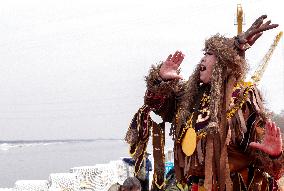
An actor of Hezhe ethnic group shouts to "awaken" the river at the main venue of Hanjiang festival in Jiamusi, northeast China's Heilongjiang Province, April 12, 2025. The second Hanjiang festival kicked off in Jiamusi of northeast China's Heilongjiang Province on Saturday, with some branch venues established in Tongjiang City, Fuyuan City, Fujin City, Huachuan County, and Tangyuan County. "Hanjiang" is an old custom in Jiamusi, of which local people shout to the river and pray for the new year's blessing and good harvest of fishing. In recent years, this tradition has evolved into a distinctive hallmark of the local cultural and tourism industry. Photo by Zhu Zongqiang/Xinhua/ABACAPRESS.COM

  •  
Hanjiang Festival - China

Hanjiang Festival - China

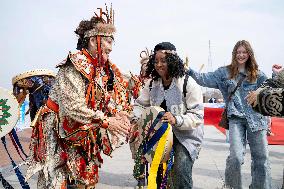
An actor of Hezhe ethnic group interacts with foreign tourists at the main venue of Hanjiang festival in Jiamusi, northeast China's Heilongjiang Province, April 12, 2025. The second Hanjiang festival kicked off in Jiamusi of northeast China's Heilongjiang Province on Saturday, with some branch venues established in Tongjiang City, Fuyuan City, Fujin City, Huachuan County, and Tangyuan County. "Hanjiang" is an old custom in Jiamusi, of which local people shout to the river and pray for the new year's blessing and good harvest of fishing. In recent years, this tradition has evolved into a distinctive hallmark of the local cultural and tourism industry. Photo by Zhang Tao/Xinhua/ABACAPRESS.COM

  •  
Hanjiang Festival - China

Hanjiang Festival - China

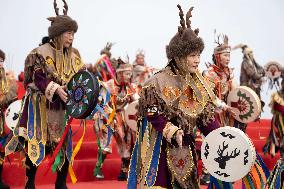
Actors perform a blessing ceremony of Hezhe ethnic group at the main venue of Hanjiang festival in Jiamusi, northeast China's Heilongjiang Province, April 12, 2025. The second Hanjiang festival kicked off in Jiamusi of northeast China's Heilongjiang Province on Saturday, with some branch venues established in Tongjiang City, Fuyuan City, Fujin City, Huachuan County, and Tangyuan County. "Hanjiang" is an old custom in Jiamusi, of which local people shout to the river and pray for the new year's blessing and good harvest of fishing. In recent years, this tradition has evolved into a distinctive hallmark of the local cultural and tourism industry. Photo by Zhang Tao/Xinhua/ABACAPRESS.COM

  •  
Hanjiang Festival - China

Hanjiang Festival - China

Actors perform a blessing ceremony of Hezhe ethnic group at the main venue of Hanjiang festival in Jiamusi, northeast China's Heilongjiang Province, April 12, 2025. The second Hanjiang festival kicked off in Jiamusi of northeast China's Heilongjiang Province on Saturday, with some branch venues established in Tongjiang City, Fuyuan City, Fujin City, Huachuan County, and Tangyuan County. "Hanjiang" is an old custom in Jiamusi, of which local people shout to the river and pray for the new year's blessing and good harvest of fishing. In recent years, this tradition has evolved into a distinctive hallmark of the local cultural and tourism industry. Photo by Chen Zhiguo/Xinhua/ABACAPRESS.COM

  •  
Hanjiang Festival - China

Hanjiang Festival - China

Actors perform a blessing ceremony of Hezhe ethnic group at the main venue of Hanjiang festival in Jiamusi, northeast China's Heilongjiang Province, April 12, 2025. The second Hanjiang festival kicked off in Jiamusi of northeast China's Heilongjiang Province on Saturday, with some branch venues established in Tongjiang City, Fuyuan City, Fujin City, Huachuan County, and Tangyuan County. "Hanjiang" is an old custom in Jiamusi, of which local people shout to the river and pray for the new year's blessing and good harvest of fishing. In recent years, this tradition has evolved into a distinctive hallmark of the local cultural and tourism industry. Photo by Zhang Tao/Xinhua/ABACAPRESS.COM

  • Main
  • Top
  • Editorial
  • Creative
  • About Us
  • About ILG
  • Terms of use
  • Company
  • BEHIND
  • Price List
  • Single Plan
  • Monthly Plan
  • Services
  • Shooting
  • Rights Clearance
  • Support
  • FAQ
  • How To Buy
  • Contact Us
  • Become a Partner

© KYODO NEWS IMAGES INC

All Rights Reserved.

  • Editorial
  • Olympics
  • News
  • Sports
  • Japan
  • Tech
  • Royal
  • Disaster
  • NorthKorea
  • Old Japan
  • SNS
  • Creative
  • Food
  • Japan
  • Landscape
  • Animal
  • Popular
  • #Ukraine
  • #Russia
  • #coronavirus
  • #N. Korea
  • #Thailand
  • #China
  • #Ukraine
  • #Russia
  • #coronavirus
  • #N. Korea
  • #Thailand
  • #China
  • Food
  • Japan
  • Landscape
  • Animal
  • Olympics
  • News
  • Sports
  • Japan
  • Tech
  • Royal
  • Disaster
  • NorthKorea
  • Old Japan
  • SNS